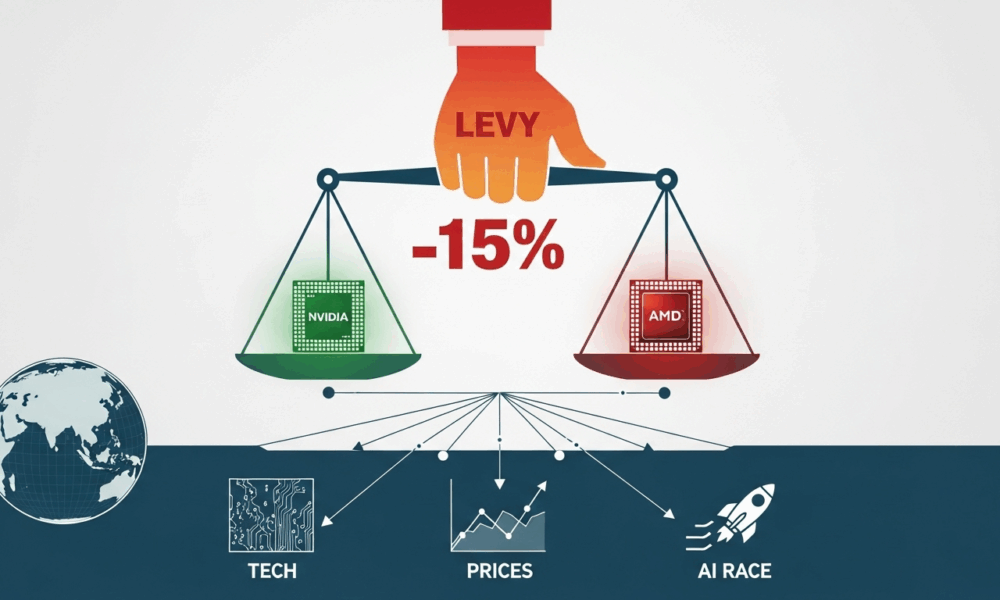
In a dramatic turn for the chip industry, the U.S. administration confirmed an agreement under which Nvidia and AMD will give 15% of revenue from specific AI-chip sales to China to the federal government. At the same time, Washington signaled it may allow a scaled-down version of Nvidia’s next-gen “Blackwell” chips for the Chinese market—while continuing to permit shipments of less advanced parts like Nvidia’s H20 and AMD’s MI308 under export licenses. Reuters
Officials framed the move as a way to keep China on a U.S. tech stack without handing over top-tier capability; analysts immediately flagged the unusual nature of a mandated revenue share linked to export approvals. The policy comes after a stop-start period for H20 shipments and suggests a calibrated approach: sell cut-down silicon, but pay a toll. Reuters
Why it matters now
- Margins & prices: Analysts estimate the levy could trim 5–15 percentage points from gross margins on affected processors, potentially nudging up end-customer prices or tightening supply prioritization elsewhere. Reuters
- Precedent risk: If a revenue skim becomes a template for other “strategic” exports, expect more policy-driven costs in semis—and possibly beyond. Reuters
- China demand still huge: Nvidia derived ~13% of total revenue from China last fiscal year; AMD about 24% in 2024—illustrating why vendors will accept tougher terms to keep a presence. Reuters
What’s actually allowed?
- Permitted (licensed): Nvidia H20 and AMD MI308—chips tuned below U.S. performance thresholds. Reuters
- Possibly permitted next: A “somewhat enhanced-in-a-negative-way” Blackwell (i.e., further performance-limited) for China, pending final decisions and licensing specifics. Reuters
Who feels it first?
- Chinese clouds & AI startups: Will likely see longer lead times or throttled performance, yet regain some access after months of uncertainty. Reuters
- Global hyperscalers: If margins compress on China-bound parts, vendors may re-optimize allocations elsewhere, subtly impacting global delivery windows. (Inference based on reported margin impact and license structure.) Reuters
- Investors: Watch guidance for mixed headwinds (levy, product downgrades) vs. tailwinds (restored volumes into a large market). Nvidia previously warned that halting H20 could trim revenue; AMD has flagged a smaller but material hit—both now partially offset by resumed, albeit constrained, sales. Reuters
Key questions to watch
- How “downgraded” is Blackwell for China? The exact caps (throughput, interconnect, memory bandwidth) will decide real-world AI training/inference impact. Reuters
- How is the 15% structured? Timing, audits, and scope (which parts, which buyers) will shape accounting and pricing. Reuters
- Will this spill into other sectors? Policy-tied revenue shares could broaden to quantum, advanced lithography, or high-end networking. (Analyst concern noted by Reuters.) Reuters
Bottom line
This is a compromise era for AI chips in China: limited performance is back on the table, but at a price—literally. Expect incremental access, policy-driven friction, and careful binning as vendors walk the tightrope between growth and compliance. Reuters
Disclaimer: This article is for information only and not investment advice.